Employees parked for several hours
Level 2 charging can often support staff vehicles over a full workday. Access control, energy reporting, load sharing, and fair-use policies may be useful when several employees share the stations.

Add workplace, fleet, tenant, customer, or public EV charging with a plan built around your electrical capacity, parking layout, daily vehicle use, Regina winters, and future expansion. Electrician Regina assesses the site before recommending charger quantity, output, controls, and supporting work.
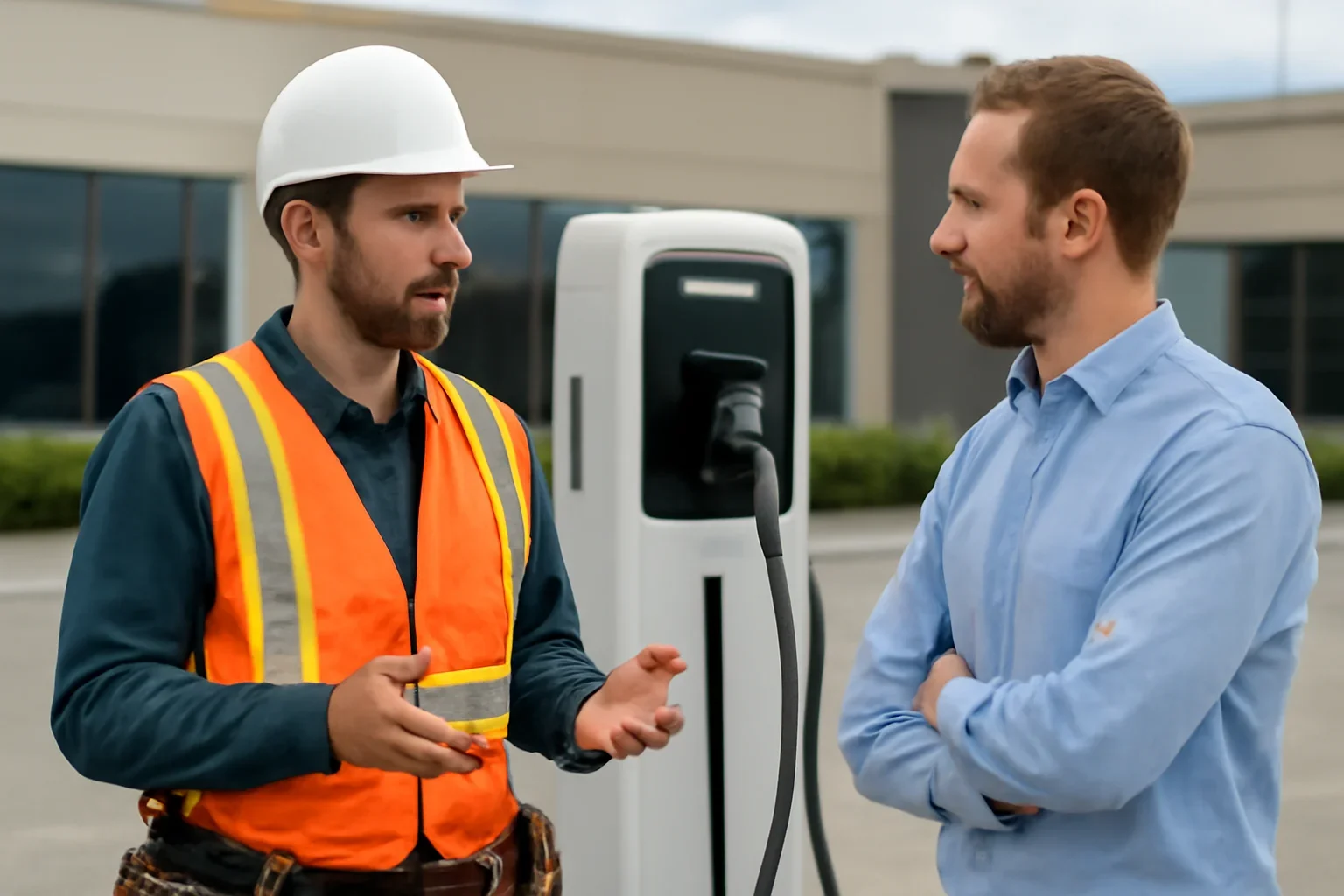
It involves more than mounting chargers. A proper project reviews vehicle dwell time, required charging speed, available service and panel capacity, parking-stall location, cable routing, network controls, snow-clearing access, protection from vehicles, permit requirements, and whether the system should be expandable. That review determines whether Level 2 charging, DC fast charging, or a phased combination is practical.
A staff parking lot, delivery fleet, apartment building, and retail plaza should not receive the same charging plan. Start with how vehicles actually arrive, park, charge, and leave.
Level 2 charging can often support staff vehicles over a full workday. Access control, energy reporting, load sharing, and fair-use policies may be useful when several employees share the stations.
Charger placement should support visibility and convenience without interfering with accessible stalls, deliveries, pedestrian routes, or normal parking circulation.
Fleet planning starts with daily kilometres, return times, overnight dwell time, vehicle count, future replacements, and the consequence of a vehicle not being charged when its shift begins.
Shared electrical capacity, assigned stalls, user billing, cable routes, ownership responsibilities, and expansion pathways should be resolved before the first charger is installed.

Charger output is only one part of the design. The installation also needs a practical route from the electrical source to the parking stalls, suitable equipment for the environment, and a way to protect the chargers from daily site activity.
For broader charger selection and residential options, review EV charger installation in Regina. When capacity is limited, a staged design or commercial panel and service upgrade may be considered after the load review.
Higher output can require substantially more electrical infrastructure. The useful question is how much energy each vehicle needs during the time it normally remains parked.
Level 2 equipment commonly operates from 208- or 240-volt power and can suit workplaces, apartments, hotels, dealerships, and overnight fleets.
DC fast charging can reduce charging time but may require higher-voltage equipment, significant available capacity, larger distribution upgrades, utility coordination, and more substantial civil work.
A design that looks reasonable on a drawing can become inconvenient once snowbanks, delivery trucks, employee parking, plows, and long cable runs are added to the picture.
Vehicle efficiency and charging performance can change in very cold conditions. Fleet and workplace plans should allow enough charging time for winter operation rather than relying only on mild-weather estimates.
Pedestals, cables, wheel stops, curbs, and bollards need to be coordinated with plowing routes and snow-storage areas so chargers remain visible, reachable, and protected.
Restaurants, workshops, warehouses, offices, and multi-unit buildings already carry different loads. Heating equipment, rooftop units, kitchen equipment, lighting, and production machinery all affect spare capacity.
Regina commercial sites often have large surface lots. Distance from the electrical room can affect conductor sizing, trenching, restoration, and the best location for distribution equipment.
Customer-facing chargers may need signage, network service, pricing rules, user support, and reliable cellular or Wi-Fi coverage. Those decisions should be made before equipment is purchased.
Installing every charger at once is not always necessary. Conduit, distribution, communications, and load-control planning can make a later expansion less disruptive to the parking lot and business.
Clear operating details at the beginning reduce redesign, unexpected civil work, and charger purchases that do not match the property.
Identify users, vehicle types, parking duration, required departure times, public or private access, preferred equipment, and likely future growth.
Review distribution, service capacity, panels, parking layout, cable route, communications, equipment location, and required site protection.
Confirm charger quantity and output, controls, electrical and civil work, permit pathway, utility involvement if needed, scheduling, and phasing.
Complete the approved work, identify the circuits, configure supported features, test operation, and review basic use and maintenance information.
Commercial EV charging prices vary because the charger is only one part of the work. Photos and basic site information can help identify whether the request is a straightforward Level 2 installation or a larger electrical and civil project.
Include the site address, property type, preferred number of charging ports, vehicle use, desired timeline, and any charger model already under consideration. A site assessment may still be required before a final scope can be prepared.
Commercial charger installations involve new electrical installation work. The project should be planned around Saskatchewan electrical permit and inspection requirements, equipment specifications, and any required coordination for service changes.
Starting with a site assessment helps determine whether the existing system can support the planned charging load, whether load management is practical, and whether the property needs distribution or service changes. For broader commercial support, visit our commercial electrician Regina page or arrange an electrical assessment.


Electrician Regina works with commercial property owners, business operators, developers, fleet managers, condo boards, and property managers across Regina and surrounding communities.
Projects may include downtown offices, Warehouse District properties, East Regina retail and service sites, Harbour Landing businesses, Ross Industrial facilities, north Regina commercial properties, apartment parking, and nearby sites in White City, Emerald Park, and Pilot Butte.
Review the complete electrical service area or explore the full electrical service directory.
Practical answers about charger type, electrical capacity, permits, installation timing, outdoor equipment, networks, and project pricing.
It depends on how long vehicles remain parked and how much energy they need before leaving. Level 2 charging is often practical for workplaces, apartments, hotels, and overnight fleets. DC fast charging may be more appropriate for short customer stops, public charging, dealerships, or route-critical fleets, but it generally requires a more demanding site and electrical review.
Some networked charging systems can distribute available power among multiple ports. This may help a property add more charging connections without every vehicle drawing maximum output at the same time. The equipment, operating schedule, calculated demand, and code requirements must be reviewed before load sharing is selected.
Commercial charging involves electrical installation work and should be planned through the applicable Saskatchewan electrical permit and inspection process. The exact permit scope depends on the equipment and supporting electrical work. Service or distribution changes may also require additional coordination.
Yes, when the selected equipment is approved for the location and the installation accounts for weather exposure, mounting, cable management, drainage, snow clearing, vehicle impact protection, and maintenance access. The charger specifications and site conditions must be reviewed before the mounting method is finalized.
Cost depends on charger quantity and output, available capacity, panel and service condition, distance to the stalls, trenching or concrete work, bollards, network requirements, permits, restoration, and whether the system is installed in phases. A site review is usually needed for a dependable commercial quote.
Multi-unit charging can be planned for assigned stalls, shared visitor parking, or a larger managed system. The review should address electrical capacity, user billing, access control, cable routing, property approvals, ownership responsibilities, and how future residents can be added.
Many commercial chargers support network features such as user authentication, payment, pricing rules, session reporting, and remote status monitoring. Features vary by manufacturer and network provider, so the operating model should be decided before equipment is ordered.
A small Level 2 project with nearby capacity can be simpler than a multi-port parking-lot or DC fast-charging installation. Equipment lead time, design, permit review, utility coordination, trenching, weather, concrete work, restoration, networking, and business access can all affect the schedule.
Tell us who will use the chargers, how long vehicles park, how many ports you need now, and what growth you expect. Include the property address, parking-area photos, electrical-panel photos, and charger specifications when available. We can then identify the most useful next step.